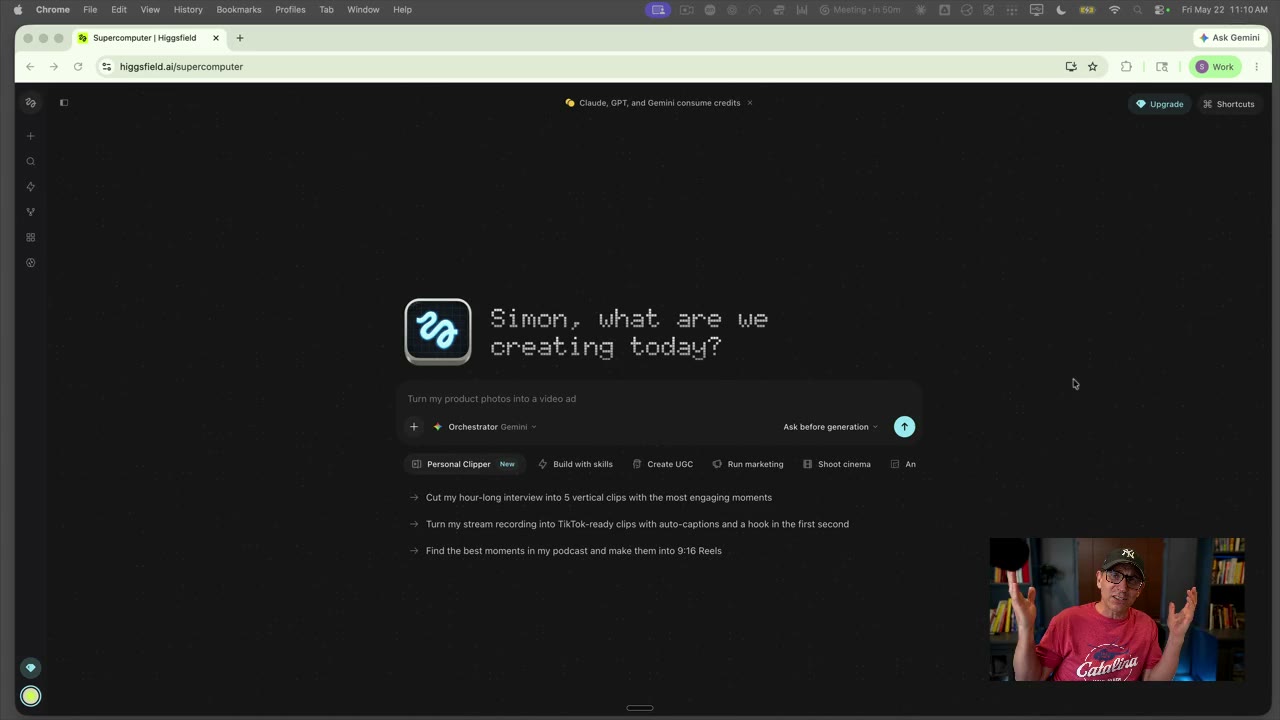
Right. So Higgsfield shipped Supercomputer ten days ago and I finally sat down with it on Thursday evening. One chat, every tool. Their answer, allegedly, to the problem Higgsfield itself created.
Because Higgsfield, as a destination, has always been the creative equivalent of someone handing me the entire Cheesecake Factory menu on platters and shoving them all in my face at once. (Brits, it's an American chain that sells a lot more than cheesecake. Bear with me.) Studio. Cinematic Build Centre. Videos. Soul ID. Nano Banana. Seedance. A dozen modes, all shouting. I'd log in and my head would hurt before I'd typed a word. Supercomputer is supposed to collapse all that into a single conversation. Walk up, ask, get.
I gave it a real brief. Here's what happened.
The setup.
First wall.. I didn't have a task. Showed up curious, nothing else. Higgsfield wanted to know what I was making today. Fair. But that's a real comment on the product direction. One-chat-every-tool only pays off if you arrive with a brief. If you don't, you bounce.
I scrambled for one. Olivia and I made a history project board on Marie Curie last term, and I had a 45-second vertical phone clip of the two of us walking through it.. props in front, the bold green-on-black panel behind. Good little artefact. I asked Supercomputer to add an opener that read *"Olivia's History Project on Marie Curie"*, sample the green-on-black for the styling, write and read a voice-over that fits the duration, and lay some pleasant music underneath. Tight, specific, doable. The kind of small creative chore you'd hand to a smart intern.
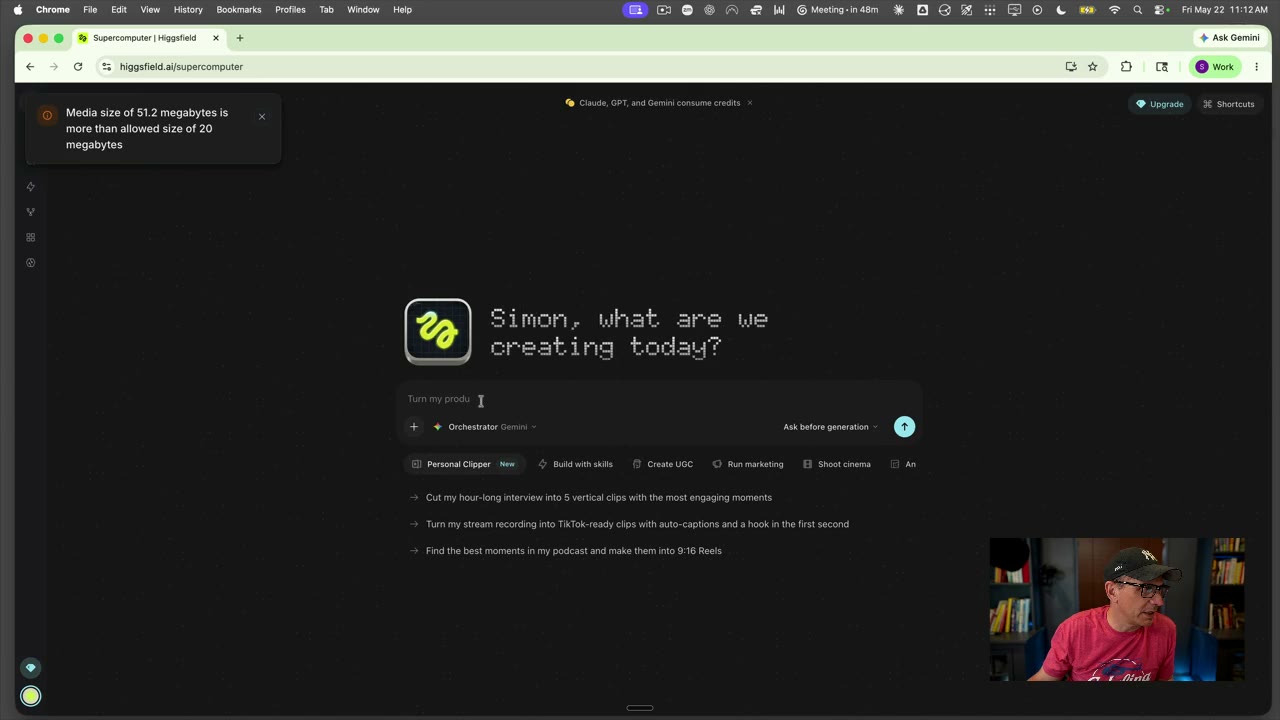
Tried to upload the clip. Hit wall number two. 20MB cap! My WAV was 51MB. For a tool that's supposed to be the answer to creative work, a 20MB media ceiling on the front door is.. an interesting choice. I shrank it and moved on. But that's a bad first impression for a video-and-audio agent, and I'm a charitable user with a workaround. Most people aren't.
Then the paywall.
Now the part that genuinely annoyed me. Typed the prompt. Uploaded the video. Hit submit. Felt good about it. Higgsfield slammed a paywall in my face. Fine, fair, the unit economics on free tokens are brutal now and I get it. I paid the $49 so we could keep moving.
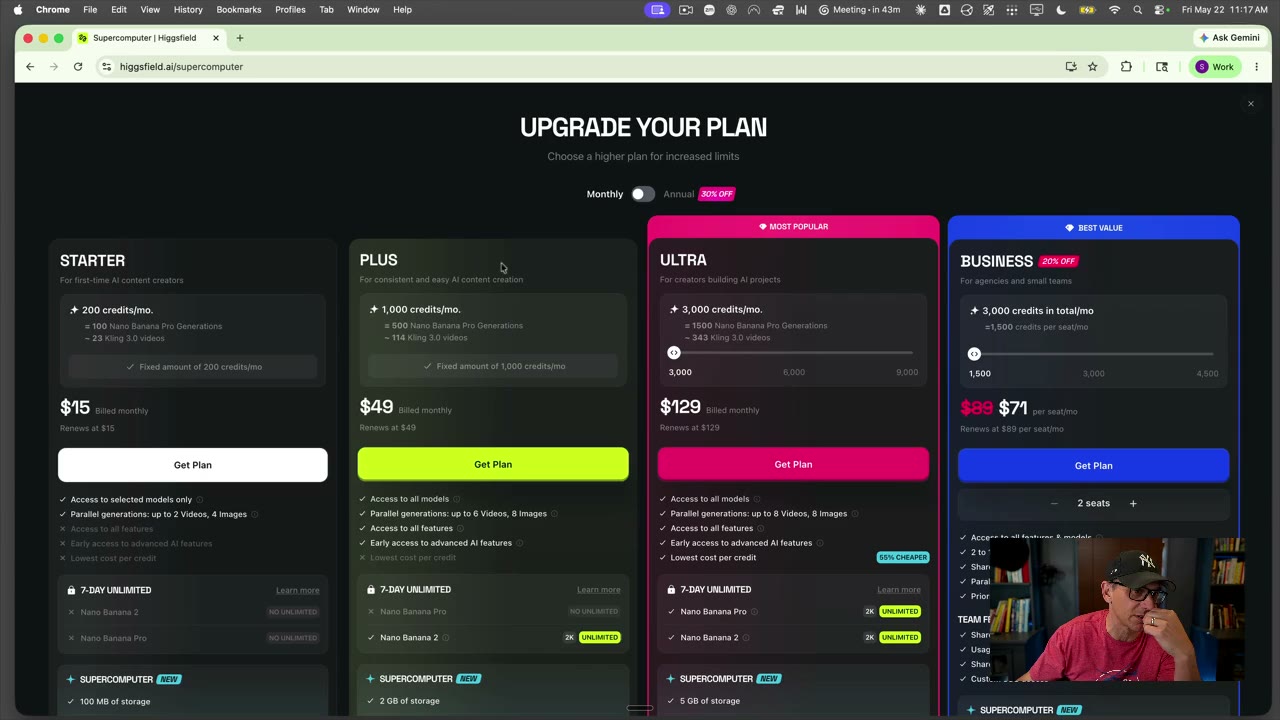
And then it dumped me back to a blank screen and wiped my prompt!
Honestly? That's the moment I would have churned, if I wasn't (figuratively) being paid to keep going. The user has committed twice. They've written a prompt. They've handed over money. And the product chooses that moment to lose both. Thank god for Whisper Flow, because I had the prompt in my clipboard. Re-uploaded the video. Re-typed the brief. Started over. And while doing that, I'd already formed the second impression I couldn't shake for the rest of the session.. this thing is not quite finished.
The opaque middle.
Agent's running. I'm watching it cycle through status messages.. analysing video.. painting the frame.. building the scene. Painting the frame. Building the scene. Painting the frame. Building the scene. For a while.
I have no idea what any of that actually means.
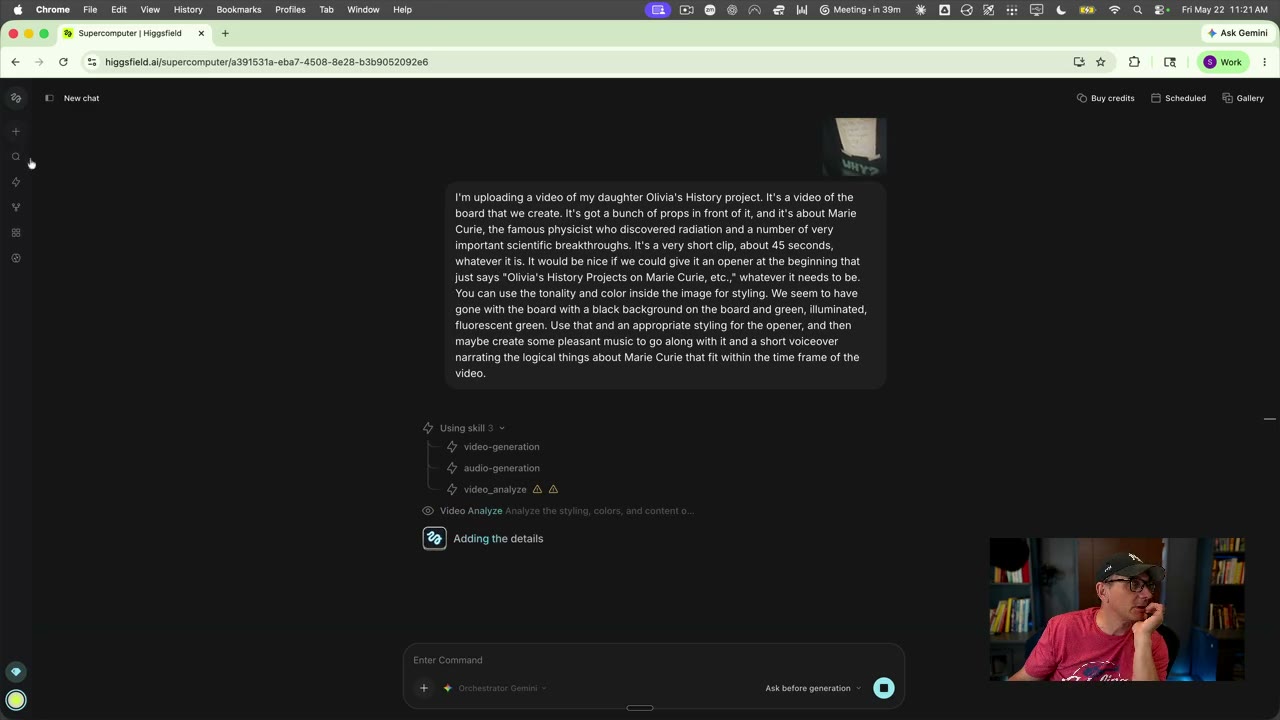
Because I work with Jony (my creative-director agent, runs on an open orchestrator), I'm used to being able to see what an agent is actually doing. The dashboard. The tool calls. Which model picked up which step. What the brief got translated into. With Supercomputer there's none of that. The status updates are decorative theatre that makes a normal user feel reassured and an experienced operator feel like the agent's gone fishing.
Verbatim from the recording. Not because I'm being theatrical. Because that was the dominant feeling for the middle section of the run. The agent might be doing great work. It might have died. It might be looping. Painting the frame, again. Building the scene, again. No collapse-the-card affordance. No tool trace. No nothing. Just vibes.
The orchestrator decided.
Eventually it surfaced and asked me to choose a voice. Credit here.. it had gone off, found a bench of voices, and let me listen to each. I picked Maya. Felt warm enough for an eight-year-old's school project. Good narration, good range. The voice work, on its own, was the strongest part of the run.
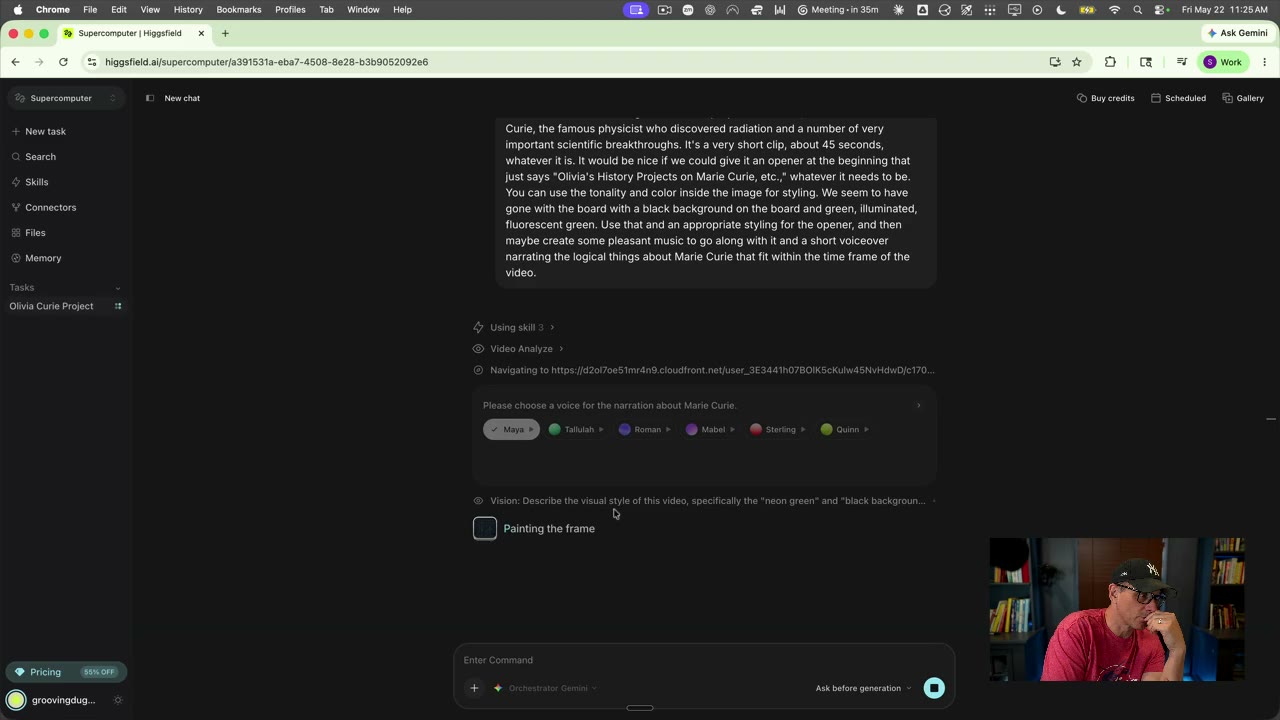
And that was the only choice it gave me.
It picked Seedance 2.0 to generate the video. I never asked for that. Didn't even know it was an option in this context. It picked the styling treatment, the opener composition, the music direction. Made fifteen small calls on my behalf. Not all of them wrong! Some were excellent. But they were all decisions, and I had not been invited to make any of them.
That's the bit that matters. The orchestrator decided. I observed. The brief was the last creative act I performed. After that the agent was off.. picking the tool, the model, the voice, the style, the output shape. I was watching, occasionally clicking approve, occasionally being offered two pre-chosen options. That's participation. Not collaboration. There's a difference.
What I actually got back.
Now this is the bit I keep coming back to. Sit with what Higgsfield actually shipped me at the end of all that.
Here they are. No edit. No spit-shine. The two artefacts the agent handed over.
Artefact 01 / Video
Artefact 02 / Voiceover
Look at those numbers again. A five-second video. A thirty-six-second voiceover. They are not the same length. They are not aligned. They are not stitched. Nothing in the agent's run said *hold on, the source clip is forty-five seconds, the voiceover should target that, the visual should sit underneath*. The agent invoked a video model. It invoked an audio model. It handed me the raw outputs and walked off.
That, right there, is the thing. That is the gap between agent with tools and creative collaborator. The whole pitch of an orchestrator is that it does the orchestrating.. it considers your source material, makes choices about how the pieces fit, edits, sequences, ties things together. Higgsfield's agent did the first half of that job, beautifully, and then dropped the dishes at the kitchen door. Two model outputs, side by side, please make of them what you will.
I want to be fair here. The individual outputs are genuinely good! Maya's narration is broadcast quality. The Seedance clip is well-composed. Two years ago this would have been a three-hour studio job. The models are doing impressive work. But the connecting tissue.. the bit where someone looks at both and says "right, now we make a thing".. didn't happen. The agent didn't see itself as responsible for that.
And what's wild is that 90% of the orchestration that did happen, the agent did invisibly. Picking Seedance. Picking the voice bench. Picking the styling. All of that decided silently behind the curtain. The one bit it didn't decide was the bit that mattered most. Editing. Composition. Finishing. The bit a creative director would call "the work".
Same brief, given to Jony.
So I did the obvious experiment. Closed the Higgsfield tab. Opened my own stack. Gave the exact same brief to Jony, my creative-director agent, who runs on an open orchestrator (we use OpenClaw, but the framework's not the point). Same clip. Same instructions. Made a cup of tea. Came back 18 minutes later.
Voiceover layered over the original Olivia/Marie Curie video. Length-matched. The opener composited onto the front, in green-on-black, sampling the panel behind us. Music sitting underneath. The actual clip of Olivia and me, walking past her board, in the video, where it belongs. A finished artefact, not two raw outputs.
Honestly, it's a bit cute.. Jony even spun up a small landing page for me to put the finished thing on, because he knew I'd want to share it. That's not a tool call. That's a creative-director move. It is exactly the connecting tissue that was missing on the other side of the experiment.
The two outputs ran on broadly similar underlying tech. Same model families. Same neighbourhood of capability. What's different is what sits on top. One stack handed me two raw model invocations. The other stack handed me a finished thing. Same building blocks, different posture about what the agent is for.
Now, the bias.. Jony is mine. I built him with my taste, my voice, my skills loaded in. Higgsfield's agent was built for everyone. Of course mine is closer. That's the whole point. The thing that made Jony's output a finished piece rather than two raw artefacts wasn't his underlying tech.. it was the orchestration logic. The taste, the judgement, the bother-to-stitch-it-together. The stuff you can't ship as a feature, because it isn't one.
The strategic worry.
Two bets on the table, and they're not the same bet. Higgsfield is betting on the orchestrator-as-app.. one polished surface, their skills, their tools, their walled garden, their opinion of what the workflow should look like. The other bet, the one that's quietly winning with the operators I trust most, is the orchestrator-as-open-framework.. you bring the skills, you pick the tools, the agent does the work. Brief is the interface. Stack is the studio. Taste is yours.
And here's where I worry for Higgsfield specifically. Their community came for the studio. They came for the tools. They came for the Cheesecake Factory menu, frankly, because the people who love Higgsfield love that they can pop into Cinematic Build Centre and twiddle knobs for an hour. Supercomputer is a shift away from that audience. It's a shift toward agentic. And it's not as powerful as a real open orchestrator yet.. because it can't be. They had to choose for you.
Which means it risks being squeezed. Alien to the studio crowd they already have (no knobs, no canvas, no twiddling). Underwhelming to the operator crowd that lives on open stacks (no transparency, no skill control, no tool selection). The Skills sidebar makes this even funnier.. it ships with Data and Analytics and Marketing and Sales skills built in. For a creative-tools brand! Bonkers. Higgsfield is, on paper, chasing a different customer than the one who bought their studio. I'm not sure either crowd is going to recognise themselves in this product yet.
Where this leaves it.
The thing that would have changed my whole evening is two changes. First, show me the trace. Let me see what tool you picked, let me swap it, let me see what voices got scored and rejected. That's collaboration, not power-user mode. Second, finish the job. If you're going to invoke a video model and an audio model, the next step is to combine them. Not later. Now. In the same run. That's the orchestration.
Directionally? Correct. The collapse of the creative menu into a chat is happening, Higgsfield knows it, the bet on agentic is right, the instinct to fix the Cheesecake Factory problem is right.
Specifically? I'm not in love with it. The 20MB cap, the paywall-then-prompt-wipe, the opaque status theatre.. all of that is fixable. The bigger thing.. handing me two raw model outputs and calling it done.. that's a product philosophy, not a bug. And it's the thing that's going to keep me on an open stack.
Anyway. One chat, every tool, no co-creator. Maya did her bit beautifully. Seedance did its bit. Nobody on Higgsfield's side did the third bit, which is the bit that turns two model invocations into a finished thing. Olivia's video is not in the video about Olivia. The orchestrator-as-app sits a long way short of the orchestrator-as-open-framework, which is where the real damn game is happening. Worth watching. If Higgsfield reads this and decides to stitch the dishes together next month, I'll happily come back and write a second take.
Si