For the longest time, I'd convinced myself Apple were falling behind on AI like everyone else. The narrative was tidy enough... OpenAI ahead, Anthropic on its tail, Google catching up, the rest of the field strewn around the track. Apple a polite no-show. Honestly, I bought into it. Then a few months ago I started noticing something didn't quite fit, and the more I sat with it, the more I think the story we've been telling each other is the wrong story.
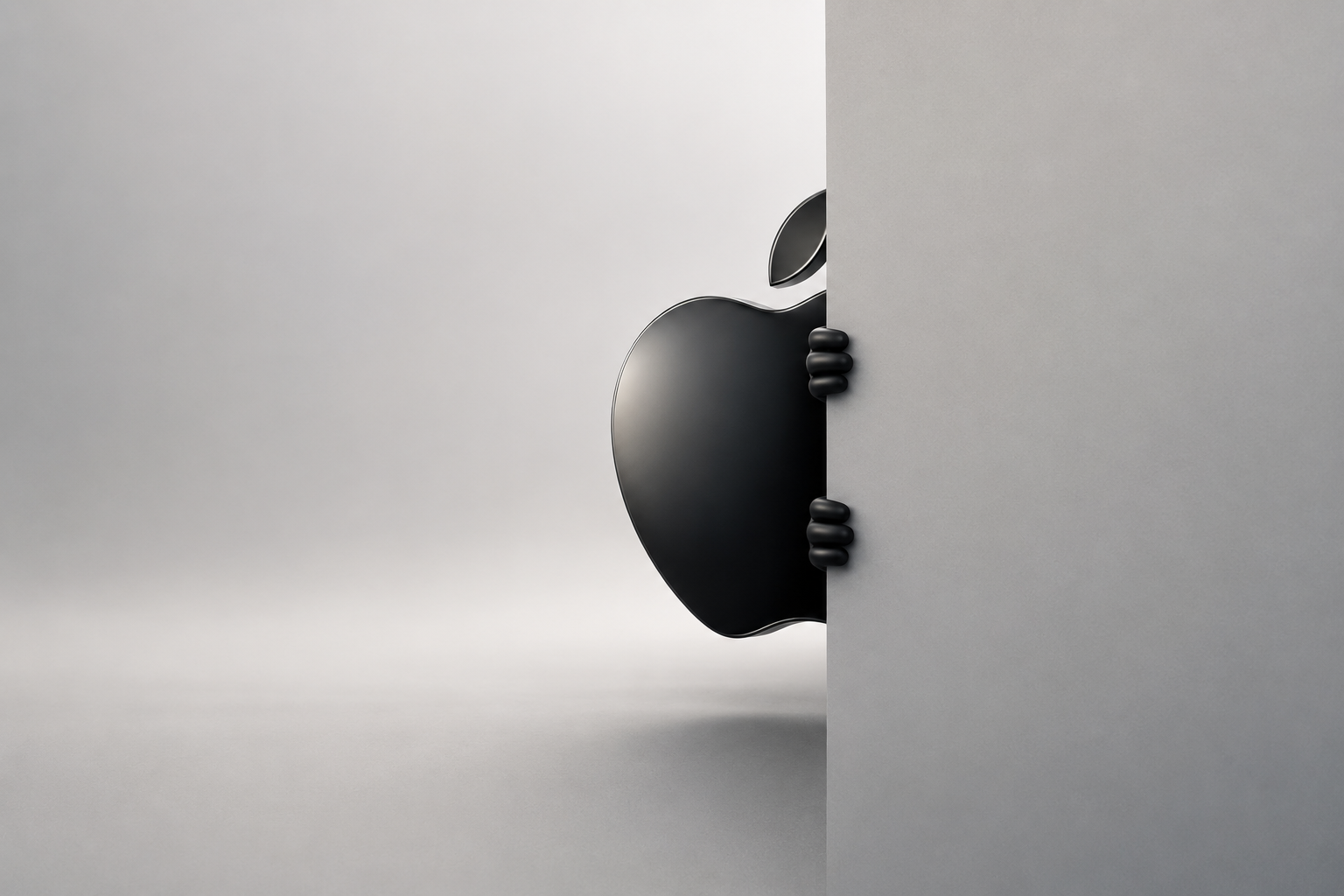
I don't think Apple are behind. I think Apple are hiding.
And I think Tim Cook stepping aside for John Ternus is the data point that makes the thesis impossible to ignore.
The Pattern
Look at Apple's headline-grade innovation over the last five years. It's been... limited. Not absent. Limited. Vision Pro arrived and underwhelmed. Apple Intelligence rolled out and felt like everyone else's, two beats slower. The keynotes have been competent rather than electric. The press, fairly, has noticed.
But that's only true if you stay on the application layer. Drop a level. Look at the chip side.
The M-series is now five years deep. Each generation has done something the rest of the industry isn't really doing... pulling everything that's normally aggregated across a stack of separate components onto a single die. CPU, GPU, neural engine, unified memory, media engines, secure enclave. One package. Architecturally specific. And the architectural choices over the last few cycles have been overwhelmingly pointed in one direction... they're optimising the silicon for AI inference.
Bandwidth between memory and the neural engine. Larger and larger neural cores. Tighter integration with the GPU shader pipeline. Tooling stack (Core ML, MLX, the Metal shader graph) that maps modern model architectures cleanly onto the hardware. None of it shouted about. All of it shipped.
For five years.
The Play
Here's what I think is actually going on, and I'll say upfront I might be wrong about some of the specifics, but I'm increasingly confident about the shape.
Apple are deliberately keeping things behind closed doors so that, when they do show their hand, the hand they show is models that are entirely optimised to run on their own hardware. Not big-brand frontier models squeezed onto a phone. Models designed, from the architecture up, to live inside the silicon they've spent five years engineering for them.
Run that forward twelve to twenty-four months. What you might be looking at is local, private, frontier-level AI running natively on every M-series chip. On every device. Free. Secure. No round-trip to a data centre. No cloud bill. No data leaving the device.
Every iPhone they've sold in the last few years. Every iPad. Every Mac. Every Vision Pro. A latent fleet of frontier-capable inference machines, just sitting there, waiting for a software update to switch them on. That's a strange sentence to write. I keep writing it anyway because the more I look at the shape of the chips and the shape of the company's roadmap, the more it fits.
The Disruption
If they pull this off, the consequences are not small.
OpenAI and Anthropic are spending tens of billions on inference-level compute. We covered the SpaceX / Colossus 1 deal in this week's newsletter... three hundred megawatts of new capacity, online inside a month, just so Anthropic users could stop hitting rate caps mid-design-system. Compute is the bottleneck of this entire era. The whole frontier is an expensive game of chasing electrons.
Local frontier inference, on a chip the user already owns, doesn't compete on that axis. It deletes the axis.
If Apple can deliver world-class intelligence locally, free, secure, on a device every creator already keeps within arm's reach, the question stops being “which API do I pay for?” and becomes “why am I paying for an API at all?” That isn't a marginal threat to OpenAI's business model. It's the whole foundation. And it isn't a marginal threat to Anthropic's, or NVIDIA's. In one move, by lining up their application layer with their own secure local models, Apple could meaningfully disrupt all three.
I don't say that lightly. NVIDIA in particular has been the unmovable centre of gravity in this category for the better part of a decade. But the only thing harder than building a frontier model is convincing every creator on the planet to keep paying for someone else's compute when their own laptop can do it for free. Especially creators, who already hate cloud bills, hate latency, and hate sending their unfinished work into a data centre they don't control.
Cook to Ternus. The Hardware Guy at the Helm.
And then, on April 24th, the news landed that Tim Cook is stepping aside. He moves to executive chairman. The new CEO, effective September 1, is John Ternus.
Ternus has run hardware engineering at Apple for the better part of a decade. He's the guy whose name shows up next to every M-series introduction, every iPad and iPhone silicon transition, every chip-and-thermals call you've ever sat through in a keynote without realising who was actually behind it. He's not a product visionary in the Jobs mould. He's not an operator like Cook. He's a hardware engineer.
Apple has just chosen to put a hardware engineer in the CEO seat.
I've been thinking about this all week. If the next five years for Apple were going to be about software, services, ecosystem unlocks, you don't pick Ternus. You pick someone whose career has been about platform expansion. The fact that the board picked the man whose entire portfolio is the chip is, frankly, the loudest possible confirmation that the chip is the strategy.
You don't put the hardware guy at the helm unless the hardware bet is the bet.
And Then, On Friday.
I'd written most of this piece by Thursday evening. Then on Friday the Wall Street Journal reported that Apple and Intel have reached a preliminary agreement for Intel to manufacture some of the chips that power Apple devices. More than a year of talks, formalised in recent months. Trump personally lobbied Cook for it in a White House meeting.
The lazy take is that this is Apple retreating. Bringing back the company they spent five years escaping. Anti-Apple-silicon. It isn't. Read it again.
Apple have manufactured every M-series chip at TSMC, in Taiwan, on the most advanced node TSMC will sell them. TSMC are extraordinary, and they are also a single point of failure. One company, one island, one geopolitical bet. If you are about to do what I think Apple are about to do... ship local frontier intelligence on every device you sell... you are about to need far more silicon than any one foundry on earth can give you. Intel's 18A node, made in the US, is the obvious second source. Samsung is reportedly in the same conversation.
You don't lock in a second foundry partner because you're scaling down. You lock in a second foundry partner because you're scaling up, and you can already see the wall TSMC alone will hit when the volume you need arrives. The deal isn't a retreat from Apple silicon. It's the operational pre-work for a much, much bigger version of it.
Hardware guy at the helm. Second foundry locked in. The roadmap doesn't make sense if the bet is small.
What This Means For Creators
Most of the people who read this newsletter make things for a living. Designers. Creative directors. Writers. Filmmakers. Brand teams. People who already work, every day, on Apple devices.
If this thesis is right, the most important AI shift of the next two years isn't going to happen in your browser tab. It's going to happen on your machine. Quietly. In an OS update. Without a press release that sounds like it.
The work you do that you don't currently dare push through a cloud model... unfinished campaigns, brand systems still under NDA, client material with sensitivity flags, the half-formed ideas you'd rather not feed into someone else's training pipeline... that work is exactly the work local frontier intelligence unlocks. Privately. On your laptop. With no cheque to clear.
That's a creative-industry change much bigger than “a new feature.” That's a structural change to who gets to use serious AI on serious creative work. The answer goes from “the people who can stomach the privacy and cost trade-offs” to everyone with a recent Mac. Which is most of us.
The Counter-Argument
A reasonable challenge to all of this: frontier models are gigantic, they're getting bigger, and even an M-series with the right architecture can't necessarily fit a model the size of GPT-5.5 or Claude Opus locally. Fair. I've thought about it.
Two things. First, the frontier-model arms race is starting to plateau on parameter count and shift toward architecture. Smaller, sharper, more efficient models are catching up faster than anyone predicted a year ago. Apple don't need to ship a model the size of Opus. They need to ship a model that's good enough on their hardware to make the round-trip-to-the-cloud feel like an unnecessary tax. Most days, for most creative work, that bar is lower than the sceptics think.
Second, even if Apple end up with a hybrid model... local for the bulk, cloud for the very heavy work... they still own the wedge. The default surface for AI on a creator's machine becomes Apple's. Everyone else becomes a fallback. That's not a small thing. That's the iPhone-and-the-app-store dynamic, applied to intelligence.
Where I Could Be Wrong
I'm laying this out as a thesis, not a prediction. Four honest disclaimers.
One, I don't have inside information about Apple's roadmap. I'm reading the silicon, the org chart, and the keynotes in public the same way you can. The rest is judgement.
Two, Apple have shown before that they can let a strategy slip. Siri stayed bad for a decade. Apple Intelligence v1 was underwhelming. There's a version of this where the hardware bet is real but the software execution stalls.
Three, the timing might be wrong. I've said twelve to twenty-four months. It might be six. It might be thirty-six. The shape feels right; the calendar is the part I'm least confident about.
Four, and this is the one that genuinely makes me pause. Training a frontier model is brutally expensive. Tens of billions in compute, megawatts of power, thousands of researchers. Apple is a public company. The infrastructure footprint... new data centres, GPU contracts, talent moves, energy deals... is hard to hide on a 10-K. Apple have form for being the most secretive company on earth, but secrecy at the scale of a frontier-training programme is a different category.
So fine. Maybe they're not training their own frontier model. Maybe what they're doing is harder to hide than I think and the lack of obvious infrastructure footprint is the real signal. I genuinely don't know.
Here's the thing though. It doesn't really matter.
If you've optimised your silicon for inference and you've got a billion devices in the wild ready to run it, the model on top is a partnership question, not a survival question. Google pays Apple twenty billion a year to be the default search engine on Safari. That's the same shape. A frontier lab, take your pick, would do an extraordinary deal to get their intelligence onto every Apple device shipped, with Apple's silicon paying the inference cost rather than the lab's data centres. Apple charge a subscription, the lab gets a per-device or per-query revenue split, both sides win.
And the killer move is the price. If the inference is local, Apple's marginal cost per query is roughly zero. They can offer unlimited frontier-grade intelligence for fifty dollars a month and still print money. OpenAI and Anthropic can't match that, because every prompt costs them real electricity in a real data centre. The platform with zero marginal inference cost wins the consumer subscription tier whether the brain is theirs or rented.
So the thesis isn't really “Apple are training a secret frontier model.” The thesis is Apple are building the only platform on which frontier intelligence can be sold for a flat fee at consumer scale. Whether the brain inside is theirs, or partnered, or some hybrid... the wedge is the same. The silicon is the moat. The model is a tenant.
But I'm a creative CEO who watches what serious companies do, not what they announce. And what Apple has been doing for five years on the chip side, paired with what they just did by handing the CEO seat to Ternus, looks more like a coherent bet than anything else I've seen them ship in a long time.
Final thought
Maybe I'm wrong. The thing about being out loud about a thesis is you run the risk of being wrong, and if I am, I'll happily say so. I don't think WWDC 2026 is the moment that decides it though. No on-device frontier model on stage in June isn't evidence the thesis is broken, it's just too early to call. The bet I'm making plays out over the next eighteen to twenty-four months, not one keynote. But somewhere along that runway, if the picture I'm painting doesn't show up, I'll write the follow-up and we'll all move on.
But if the next twelve months play out roughly the way I think they will... if local, private, frontier intelligence shows up on every M-series device, free, secure, integrated through the application layer... then a lot of business plans are going to have to be rewritten in a hurry. And we'll all be sitting here, looking at the keynotes from the last five years, wondering how we missed it.
It made me think the other day...
Maybe they called it Apple Intelligence for a reason.