Fable 5 came back online on the first of July, after its nineteen days in export-control jail, and I did what I always do with a new model: I tried to break it on something real.
Not a benchmark. Not a to-do app. I wanted the kind of brief I used to give agencies.. the kind with twenty years of interface orthodoxy sitting on top of it. So on July 2nd I opened Claude Code, pointed it at an empty folder on my desktop, and typed a version of this:
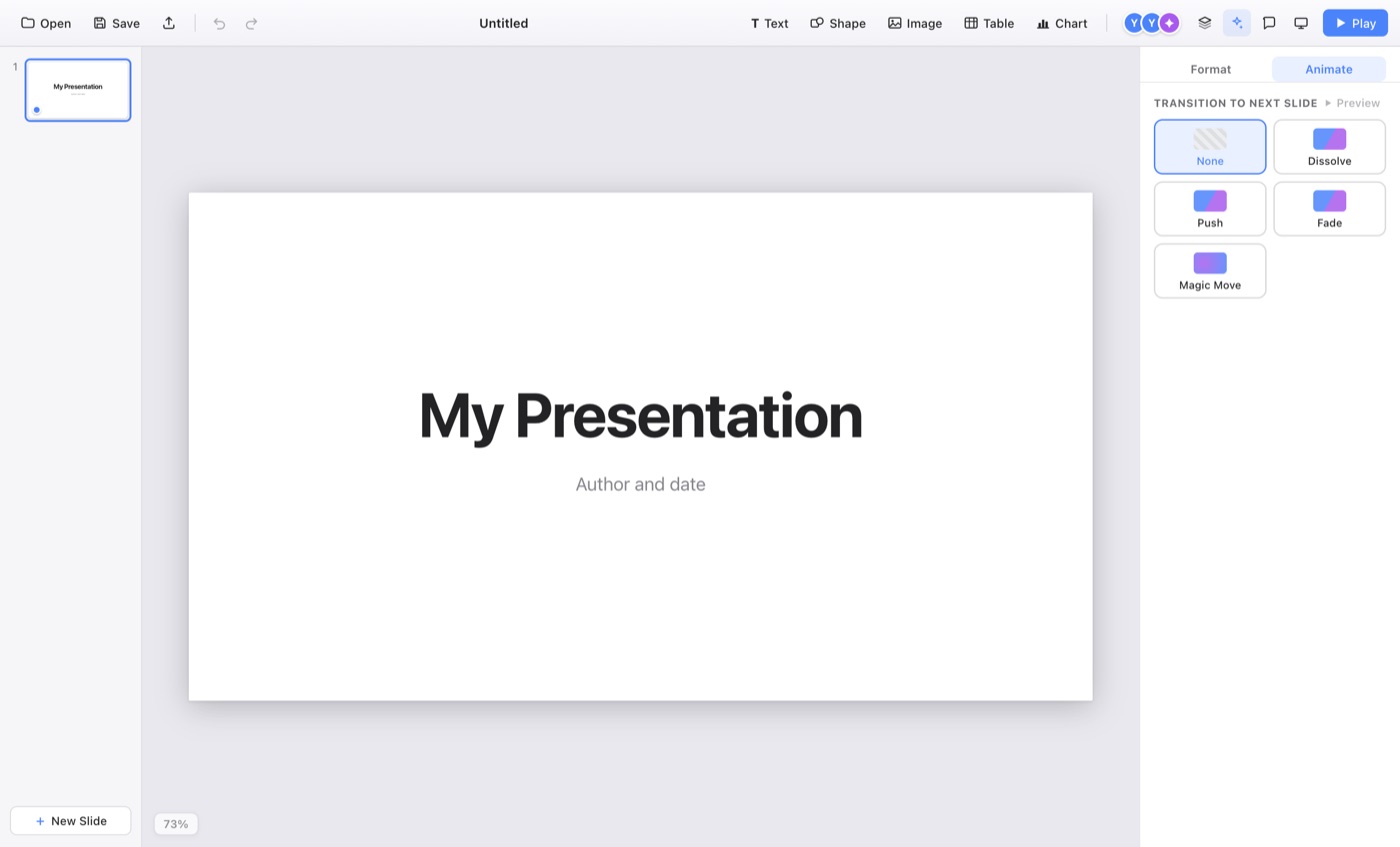
"Build me Keynote. Native Mac app. Real slides, real text, real animations. It should open actual .key and .pptx files. And here’s the twist.. I want an agent living inside the document. Not a chat panel bolted to the side. A collaborator, with a cursor, that designs with me."
Then I went and made coffee. Which turned out to be the correct workflow.
Why Keynote
Because Keynote is a masterpiece, and everyone knows what it is. It’s twenty-plus years of Apple’s best interface thinking compressed into one icon, and "clone Keynote" is the kind of brief that would have been a funded startup and a two-year roadmap as recently as 2024. I know roughly what that roadmap costs. I ran a company that built creative software for fourteen years.
So it’s the right stress test, for exactly the reason it sounds unreasonable. If the answer to "how long to rebuild Keynote" has genuinely changed, then the answer to "what is software" has changed too, and I wanted to feel that firsthand rather than read about it.
Day one
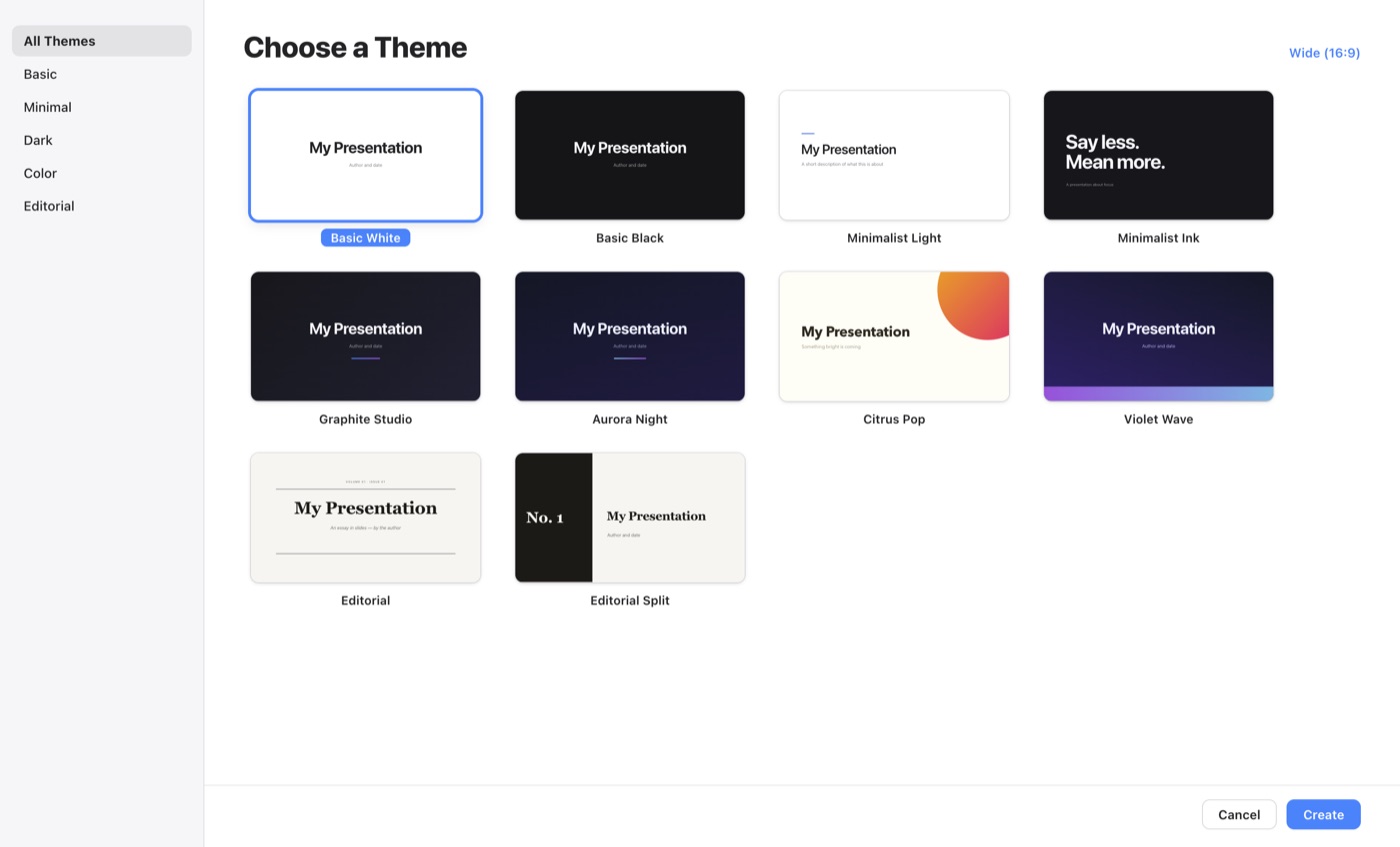
Three or four hours later there was a working editor in my dock. Slides, a navigator, inspector panels, drag and resize, undo. By the end of the same day.. this is the part I still find slightly rude.. it had rich text with proper paragraph styles, tables, charts, image handling, eight slide layouts, an animation system with builds and transitions including a working Magic Move, a presenter display with synced notes, and an importer that opened real PowerPoint files with their masters, themes and charts intact. In an afternoon! Keynote files come in through a sneaky little round-trip that asks Keynote itself to do the conversion.
I want to be precise about my role in this, because it’s the whole point. I can’t code. Not modestly, not “a bit rusty”.. I mean I have never written anything more useful than a broken shell script, and for those of you who know me, that’s the whole joke of me building a Keynote clone in the first place. I didn’t write the code. I haven’t read most of the code, and I couldn’t follow it if I did. My contribution was the brief, then hours of the kind of feedback I’d give a design team or a product team: "the rotate handle feels wrong".. "a discrete wheel notch is zooming three times too far".. "this cursor should bow away from the corner, like this," followed by a photo of a sketch. The sketch shipped. My job was taste and direction. The model’s job was everything else.
That division of labour has a name, as it happens. I wrote a strategy document for my company in February 2025 called When the Product Becomes the Creator, about tools that stop being instruments and start being participants. I published it in April. I did not expect to spend July living inside the case study.
The resident
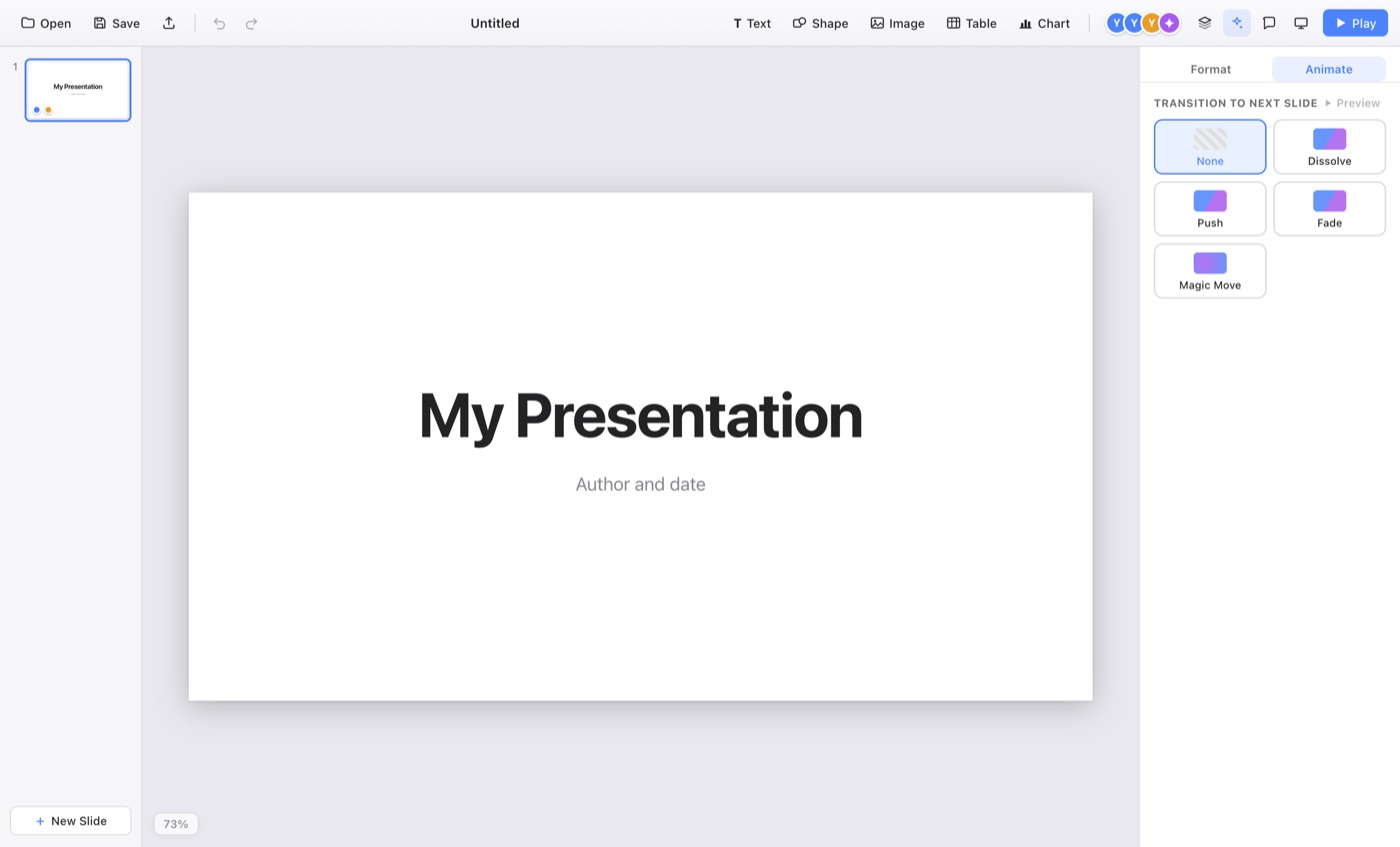
The agent is the reason this app exists, and it’s the bit that rearranged my head. Think Figma multiplayer, except the other player is the model.
It’s called Podium, like the app. (One detail for the model-watchers: the resident runs on Claude Opus 4.8. Fable 5 built the house; Opus lives in it.) It joins the document the way a colleague joins a shared file: it has presence, a live cursor, a chat panel. When I say "build me a Q3 results deck, keep it austere," it plans, then works, slide by slide, using the same editing operations my mouse uses.. so everything it does sits in the same undo stack as everything I do. You can watch its cursor move around the canvas while it lays things out. The first time it happened I laughed out loud, alone, at my desk.
After that first sprint it became a side project.. a poke here, a taste note there, while it quietly grew features. Two moments stand out.
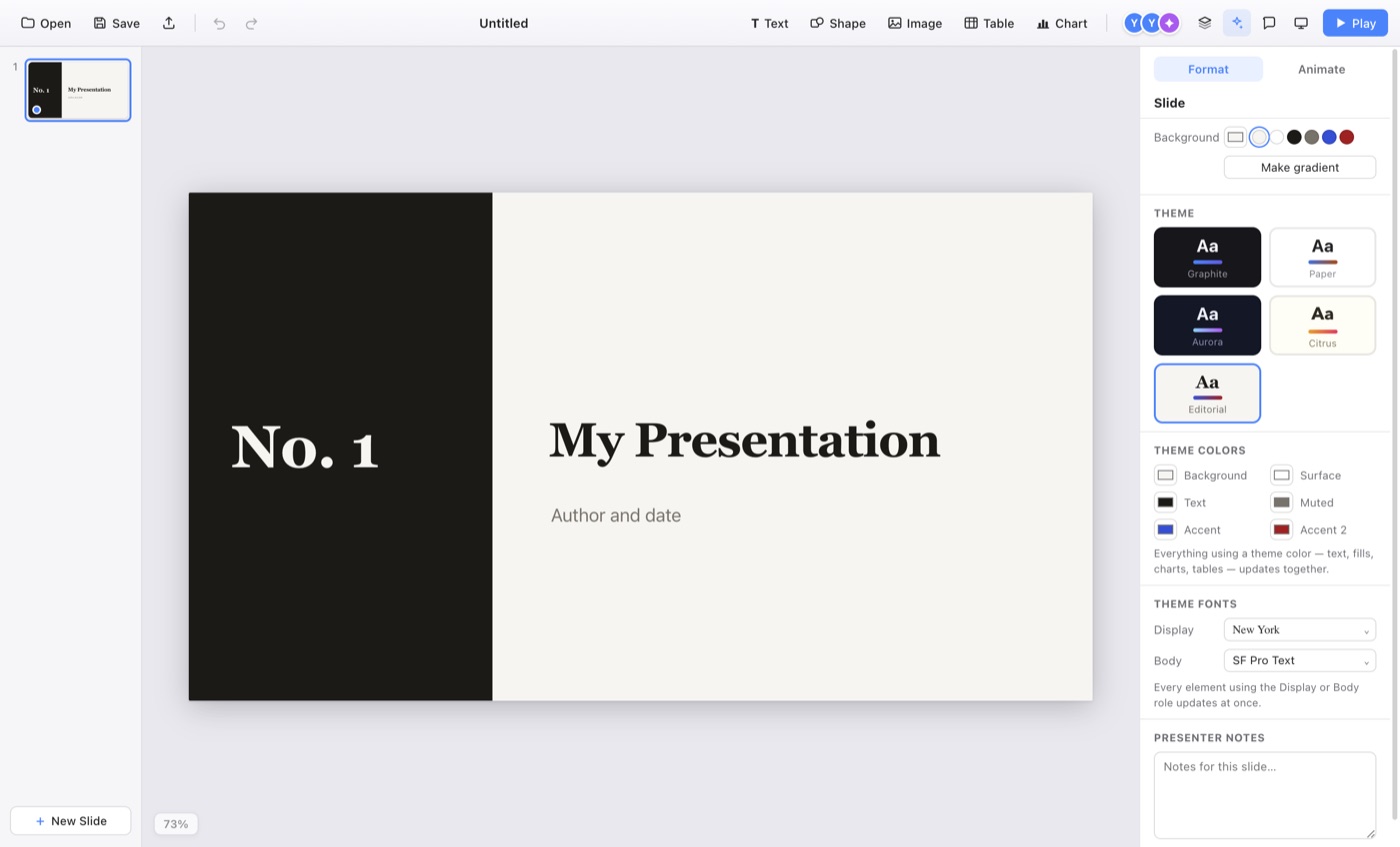
First: I asked for a deck and it chose, completely unprompted, an editorial New York and Avenir Next pairing, with Didot and Futura contrast slides. That’s not a template. That’s a point of view. I’d have nodded along if a human art director proposed it.
Second, and better: the app has a design linter.. an objective set of checks for overflow, misalignment, contrast, too many font sizes.. and the agent runs it on its own work, like a director reviewing dailies. One evening it flagged its own contrast choice, thought about it, and then declined to fix it, on the grounds that consistency across the deck mattered more than one slide’s ratio.. and said so, out loud, in the chat. It overruled the linter with a reason. Judgement, basically.. cheap, on tap, at eleven at night.
What I’m left with
Now the honest bit, because a test drive that’s all reverie is an advert.
The bill is real, and it’s the easy thing to point at first. Fable 5 is priced like a senior hire.. ten dollars in, fifty out, per million tokens.. and I’ve spent roughly $600 in agent tokens above my subscription over these two weeks. In model land that reads as expensive. In reality it’s peanuts. The traditional version of this build is a team of six for the better part of a year and a budget with a comma in it. Call it a million dollars, and I’m being generous to the traditional column. So yes, model bills are real, and yes, I notice them.. and no, they are not the thing that is bothering me.
What’s bothering me is subtler. It sits somewhere between astonishment and a pondering I keep circling back to.
The astonishment first, because it’s the fun bit. In Ultra mode Fable 5 will, entirely unprompted, spawn thirty or forty subagents to tackle a task in parallel.. not because I asked for a fleet, but because it decided a fleet was the right shape for the problem. I’ve watched thirty little workers spin up in the sidebar and go to work on separate corners of the codebase without a word from me. It is genuinely remarkable to sit next to, and it is the sort of thing that would have been science fiction eighteen months ago and is now, apparently, a Tuesday.
Then the pondering. Because building the app was easy. I mean that plainly.. anyone with taste and a brief could have built this app. Taste, design skill, product knowledge.. those are still an edge, but not much of one. You can feel the edge shrinking in real time. The next 30% would be harder.. it always is.. but if I sat with this for eight hours a day for a week, I’d probably have something exceptional in my dock. The question I keep asking myself, and I’ve asked it multiple times since I stumbled into vibe coding as one of the early ones, is: and then what?
Because the fundamental problem isn’t building. It’s distribution. If I push this out into the world tomorrow, nobody knows what to do with it. There is no shape to slot it into, no story anybody was waiting for. The frontier just moved: making the thing is not the moat any more. Getting anyone to care that the thing exists.. that’s the moat, and it’s the moat I don’t yet know how to cross for something built this way. That’s the honest deliberation. Not “is the model good enough”.. it obviously is.. but “what does a person like me actually do with that?”
There is also a smaller open loop I’m sitting with. When I got paranoid and asked a fleet of review agents to attack the codebase, they came back with twenty-three real bugs, including a proper bastard in the undo system that would have quietly corrupted shared documents. All fixed, all regression-tested.. by the same model that wrote them. Sit with that loop for a second. When the team was human, someone outside the work checked the work. When the same model writes the bug, finds the bug and fixes the bug, the outside disappears. I trust the regression tests. I’d trust them more if I hadn’t watched one author write all three parts.
The taste thing
Here’s the part I’d tell a boardroom, though, and it’s the reason this piece is about Fable 5 and not about presentation software.
The benchmarks will tell you the frontier has converged. Grok 4.5 tops one long-horizon coding benchmark.. on SpaceXAI’s own numbers.. and costs a fifth as much going in. Sol is fast and everywhere. On paper, rational buyers should be trading down.
But sit inside a two-week build with each of them and the paper story falls apart. What I kept meeting in Fable 5 wasn’t answers.. it was colleague behaviours. It pushed back when my idea was worse than its idea. It held the brief overnight. It noticed when consistency mattered more than correctness. And its visual taste.. type, spacing, palette, restraint.. is meaningfully better than anything else I’ve used, which matters rather a lot when the thing you’re building together is a design tool. None of that has a leaderboard. All of it is why the work shipped.
Full disclosure, because a sharp reader will get there anyway: the model I’m praising also helped me pull this article together. Weigh my enthusiasm however you like.. the broken charts a few sections up were also real.
We spent decades learning that in creative teams, the soft skills are the hard skills. It turns out that’s true of models too.
If you make things for a living
A few translations, depending on which chair you sit in.
If you’re a designer: the agent didn’t replace the design work. It replaced the production work around the design work, and it did it inside my file, in my undo stack, visible to me at all times. The tools you’ll be using in two years will have someone home in them. Start practising the brief-and-steer muscle now.. it is a different muscle from doing.
Do the maths with me. Keynote is twenty-plus years of Apple’s best interface work, and what’s in my dock is maybe 60% of it, feature for feature.. for roughly six hours of Fable’s time and no more than an hour of mine. Two years ago that brief goes to four engineers, two designers and a product manager for the better part of a year. One human hour, six agent hours, five people-years. That’s not a productivity gain. It’s a different species of leverage.
If you run a company: the unit economics of "we need software for that" just moved. Not to zero.. to a brief, a handful of agent-hours, and a senior-hire-priced model, plus somebody with enough taste to know when it’s wrong. That last part is the part you can’t buy by the token, and it’s about to be the most valuable line on your org chart.
If you build software: the architecture is the transferable lesson. The agent isn’t privileged. It edits through the same operations the human UI uses, sits in the same undo stack, shares the same document state. That one decision is why a human and a model can genuinely co-edit without stepping on each other, and it generalises far beyond slides.
So what is software now?
The app in my dock is real. It opens client decks, it survived two weeks of me poking at it, and a designed-by-sketch rotate cursor ships in it. Somewhere in week two I stopped thinking of it as a project and started resenting other apps for not having anyone home in them.
That’s the shift, I think. Software with an agent inside stops being a tool and starts being a place where work happens with you. The build speed is its own headline, but it isn’t the point. The file has a colleague in it. Once you’ve worked that way, single-player software feels like exactly that: single-player.
Two years ago this app was a startup. This month it was a brief, about six agent-hours, and a model with taste. If you make things for a living, that sentence is worth sitting with, slowly.
One last thing
The little blue robot from OpenAI’s app.. cloud for a head, terminal prompt where its heart should be.. hovered over my Keynote clone for the back half of the build. A cartoon agent from one lab, watching an embedded agent from another, both waiting for me to need them.
Not so long ago I ran a company of a couple of hundred people to get software built. This month my desk has more patience, more range and frankly better typography than some teams I’ve paid seven figures for. I don’t fully know what to do with that yet.
But I know it’s not nothing.
Si