Right, so. I’ve been running OpenClaw for about six months. If you don’t know it, it’s the open-source agent harness that started life as Clawdbot, got renamed to Moltbot, then renamed again to OpenClaw, which tells you something about the neighbourhood. It is genuinely brilliant... it is also the sort of brilliant that costs you a weekend.
On Wednesday afternoon I installed Grok Bot instead. It took about four minutes.
This is what I found.
What the old way actually costs
I want to be fair to OpenClaw here, because I like it and I still have it. But let’s be honest about the on-ramp. The project’s own documentation will tell you that you need an API key and a machine. What that means in practice, if you follow one of the full production write-ups, is a VPS at about five euros a month, two or more vCPUs, four gigs of RAM, forty gigs of SSD, Ubuntu, Node 22 or better, and Docker. Then the terminal. Then the config. Then the gateway.
None of that is hard for an engineer. All of it is a wall for everyone else. One of the more honest summaries I read put it plainly: OpenClaw requires Docker, Node.js and terminal commands, which makes it inaccessible to non-technical users.
I am a non-technical user. I have never written a line of code. I got there anyway, because I am stubborn and because I had six months, but I could not in good conscience have told anyone at my agency to go and do the same thing on a Tuesday.
Worth noting: Peter Steinberger, who created the thing, left to join OpenAI in February. He said he wanted to change the world rather than build a large company. Read into that what you like about where the usability problem was going to get solved.
Wednesday afternoon
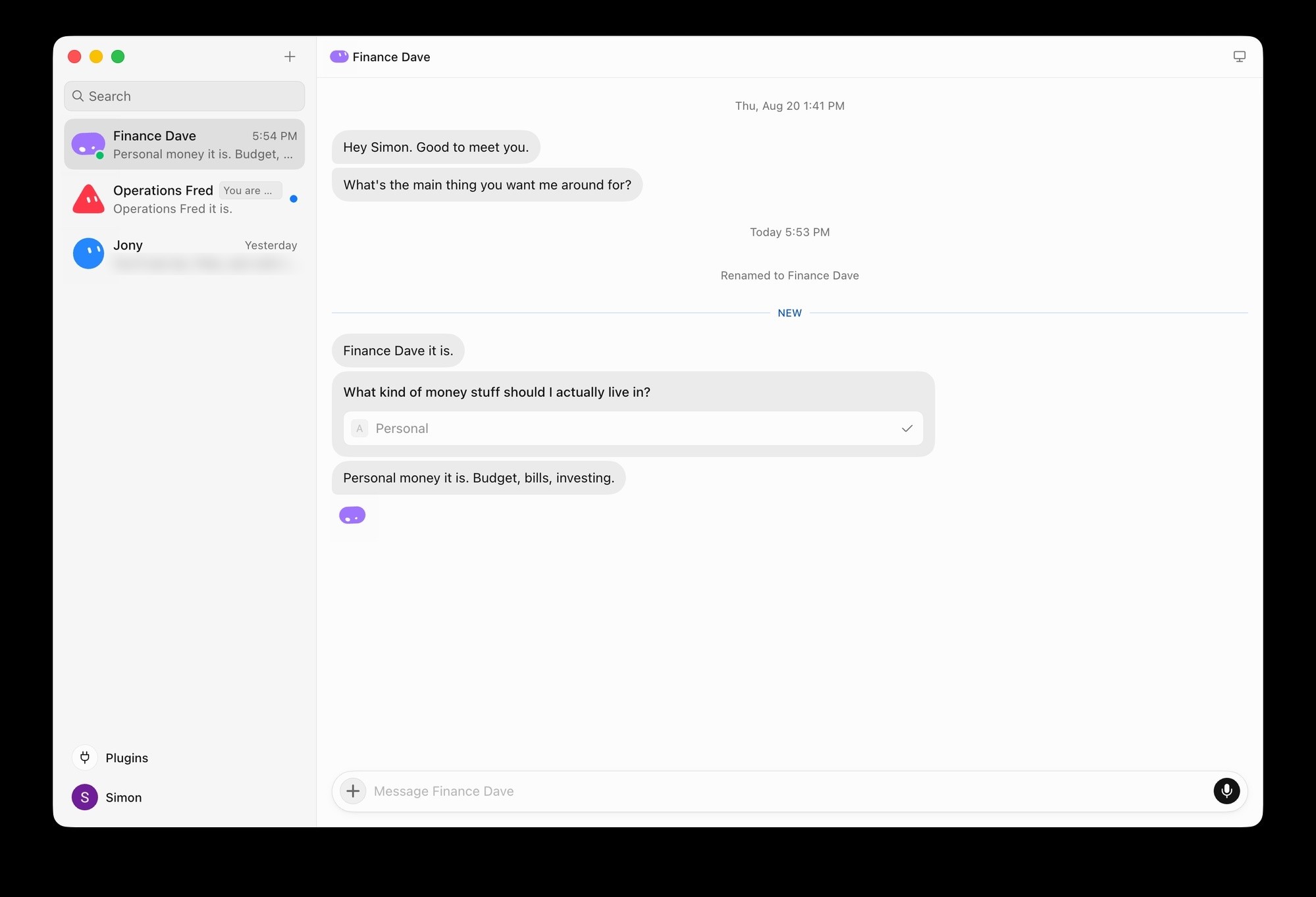
Grok Bot is an app. You download it, you pay for a subscription, and you are off. That is the entire setup story.
There is no VPS. There is no Mac mini in a cupboard. There is no evening spent comparing cloud providers to find something that will host a persistent Linux box for you at a sane price. The computer is just there, spun up, waiting. I did not have to think about it once, which after six months of thinking about it constantly was a slightly strange feeling.
Connecting things is the part that really landed. In OpenClaw, adding a new service is a project. In Grok Bot it is a click. You open Plugins, you find the thing, you authorise it in a browser tab, you are done. Mail, calendar, Slack, Notion. A click away, not seventeen prompts away.
It is the same idea, made consumer
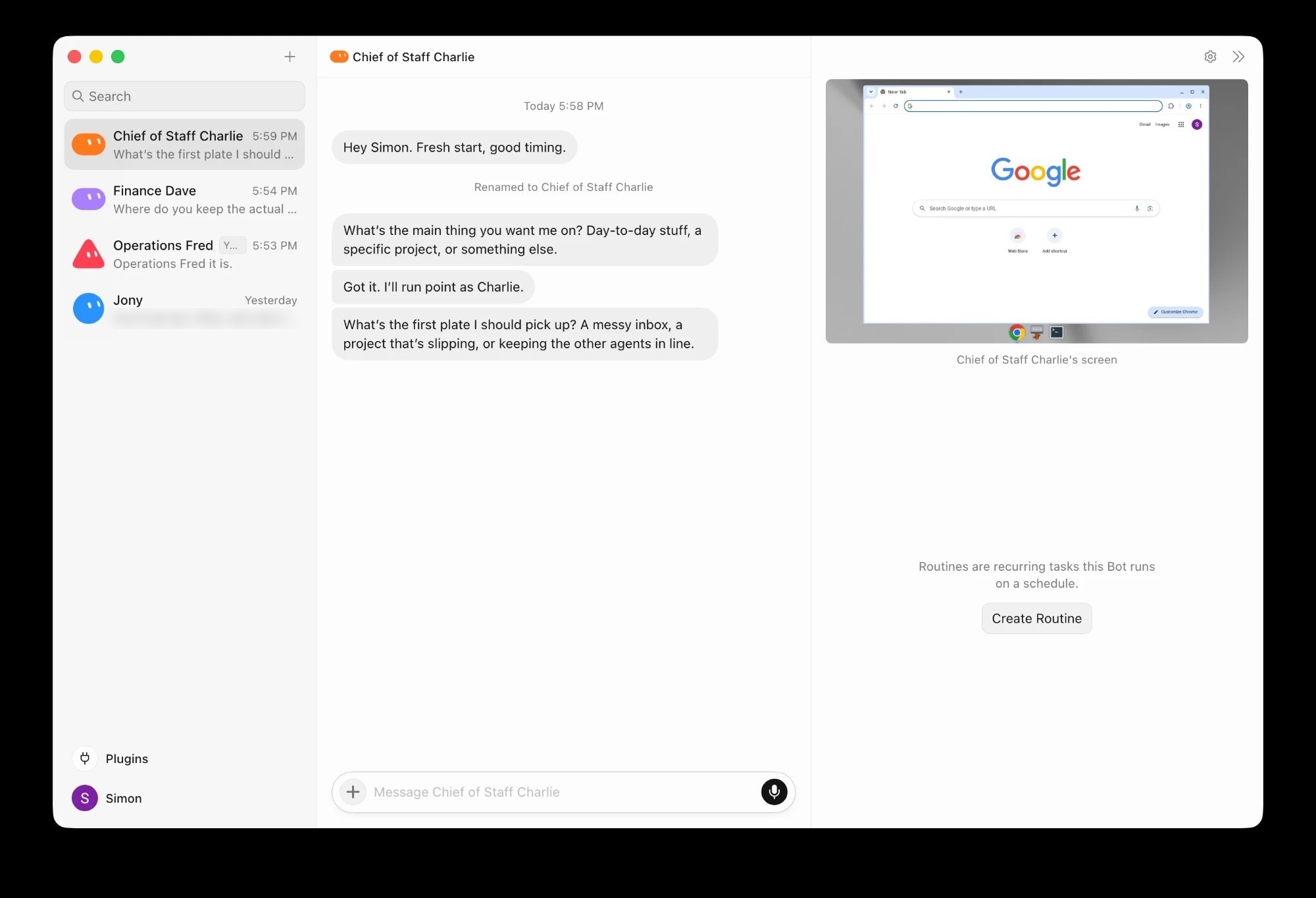
Underneath, the shape is familiar. There are agents. There is a machine. If you screen share to it you can watch what it is doing and take over when it gets stuck, which is exactly the OpenClaw feeling and exactly the right design.
Spinning up a new Bot takes seconds. You give it a name, an avatar, a persona, a job. Then you can have several of them and they hand work between each other. There is a cap of fifty Bots and group chats on an account, which I mention only because I was curious enough to go and look, not because I am anywhere near it.
So the honest summary is this: they have taken all the complicated stuff that goes into standing up an OpenClaw, and made it consumer-friendly. Not more powerful. Friendlier. Those are different achievements and this one was the harder sell.
The clever bit nobody is talking about
Here is the thing I did not expect to be impressed by, and was.
Sharing secrets with an agent is one of the genuinely annoying problems in this whole category. You need the thing to have a key, or a password, or a token. So you paste it into a chat window, and now your credential is sitting in a transcript forever, and probably in a model’s context, and you feel a bit sick about it.
Grok Bot handles it properly. When a Bot needs a credential it raises what xAI calls a secure secret request, a separate masked field rather than the chat. Their own documentation is blunt about why. The value, it says, is masked, excluded from the transcript, and not shown to the model. And elsewhere, in case you were considering it: do not send a password or one-time code in ordinary chat.
It is not a password manager and they say so. It is a small, well-designed solution to a small, constant irritation. Which is usually what separates a product from a project.
Where it falls down
The design work is not good. I asked it for UI and what came back was weak, and noticeably weaker than what I get from Claude for the same kind of request. Layout, hierarchy, taste... it was all fine. Fine is not what I want.
I am going to caveat that heavily, though, because I might be holding it wrong. I have not connected it to Cursor, and a chunk of the power here clearly lives in that direction. It is entirely possible this is a configuration problem, or a skills problem, or simply me not having spent long enough on it. Treat that paragraph as a first impression, not a verdict.
The other thing worth knowing is the bit that is easy to miss, and it is a security point rather than a taste one. The marketing says each Bot gets a computer of its own. The documentation, on the same page, says the opposite: all of your Bots share one cloud computer, and files, browser cookies, signed-in sessions and command-line credentials are shared across every one of them. The per-Bot screens are, in their words, separate work surfaces, not separate security boundaries. There is even a flat instruction: do not use separate Bots as a security boundary.
So do not give one Bot your finance logins and assume the other one cannot reach them. It can.
What everyone else made of it
I am not the only person who spent the week on this, and the reaction has been unusually consistent, including from people who normally are not easily impressed.
Lenny Rachitsky, who writes Lenny’s Newsletter, got early access and landed on almost exactly my comparison: it’s like OpenClaw, but super easy, reliable, and less scary to use. Gergely Orosz of The Pragmatic Engineer, who paid for the upgrade himself and is usually the one puncturing this sort of thing, called it the “Claude Code” moment for “normie” knowledge work. OpenClaw without needing to know anything about OpenClaw. Alex Lieberman, who co-founded Morning Brew and is a media operator rather than an engineer, said the word he would use for the experience is simply easy.
The dissent is worth as much. Claire Vo, Chief Product Officer at LaunchDarkly, set up five Bots, ran the whole thing through her own scoring, and finished the week with a line I keep thinking about: I still reach for my OpenClaws. Brian Lovin, the designer behind Campsite, liked the mental model but found the agents loop when they talk to each other, and pointed out you cannot interrupt a Bot mid-task or queue a message behind it. Matt Shumer’s complaint is that you cannot pick or pin which model handles a job, and xAI does not publish what the router chose.
That range feels about right to me. Enormous leap in accessibility. Not yet the most capable thing in the room.
So, should you
If you have never got an agent harness running and you have been meaning to, yes, obviously. This is the easiest door into the room by a distance. Five times easier than an OpenClaw setup, probably ten.
The price moved while I was writing this, which was mildly annoying. When I signed up, the only ways in were two hundred dollars a month or three hundred. I paid the two hundred. By the end of the week there was a sixty dollar tier and a hundred dollar tier. If you are about to do this, do not repeat my week: check the current plans first, and buy on the web rather than inside the iPhone app, because Apple’s cut makes the identical plan about a third dearer.
The mobile app is genuinely nice, which I did not expect. Being able to check on a Bot from the car turns out to change how you use the thing.
What I keep coming back to is that this is the second time in a month I have watched a category go from “you need to be technical” to “you need to be curious”. That happened with my house. It has now happened with agents. The thing that was gatekeeping it was never the intelligence. It was the setup.
Si