Three new models landed this week and I did not open a single one of them. I was flat out with work, and for once I let them go past.
Then on Saturday I was ill, the newsletter was in someone else's hands, and I finally had an afternoon with nothing in it. So I picked one. Claude Opus 5.5. And I gave it the kind of brief I would give a motion designer I wanted to impress me.
The brief
This is the whole thing, typos and all.
I want you to make a dynamic 15-second motion graphics video that shows what an incredible motion designer you are, like it's your showreel for a résumé. go all out!!! Blow me away.
I told it to use my site as the guide for colours and style, stretch the brand a little if it wanted, and attached my logo.
The first thing it did was not design anything. It opened simonberg.ai and read the site's own style settings, rather than guessing from screenshots. The fonts. The reds and the darks. The gradient I use for Jony. The little red square I use as a full stop. The scrolling ticker of phrases that runs across the homepage.
Those phrases became the script.
Thirty minutes later
It set the whole piece to music at 128 beats per minute, because at that tempo eight bars last exactly fifteen seconds. So the film is eight scenes, one bar each, and every cut and every hit lands on a beat. Then it wrote the soundtrack from the same timings, so picture and sound could never drift apart. That is the kind of decision a good motion designer makes before they open anything.
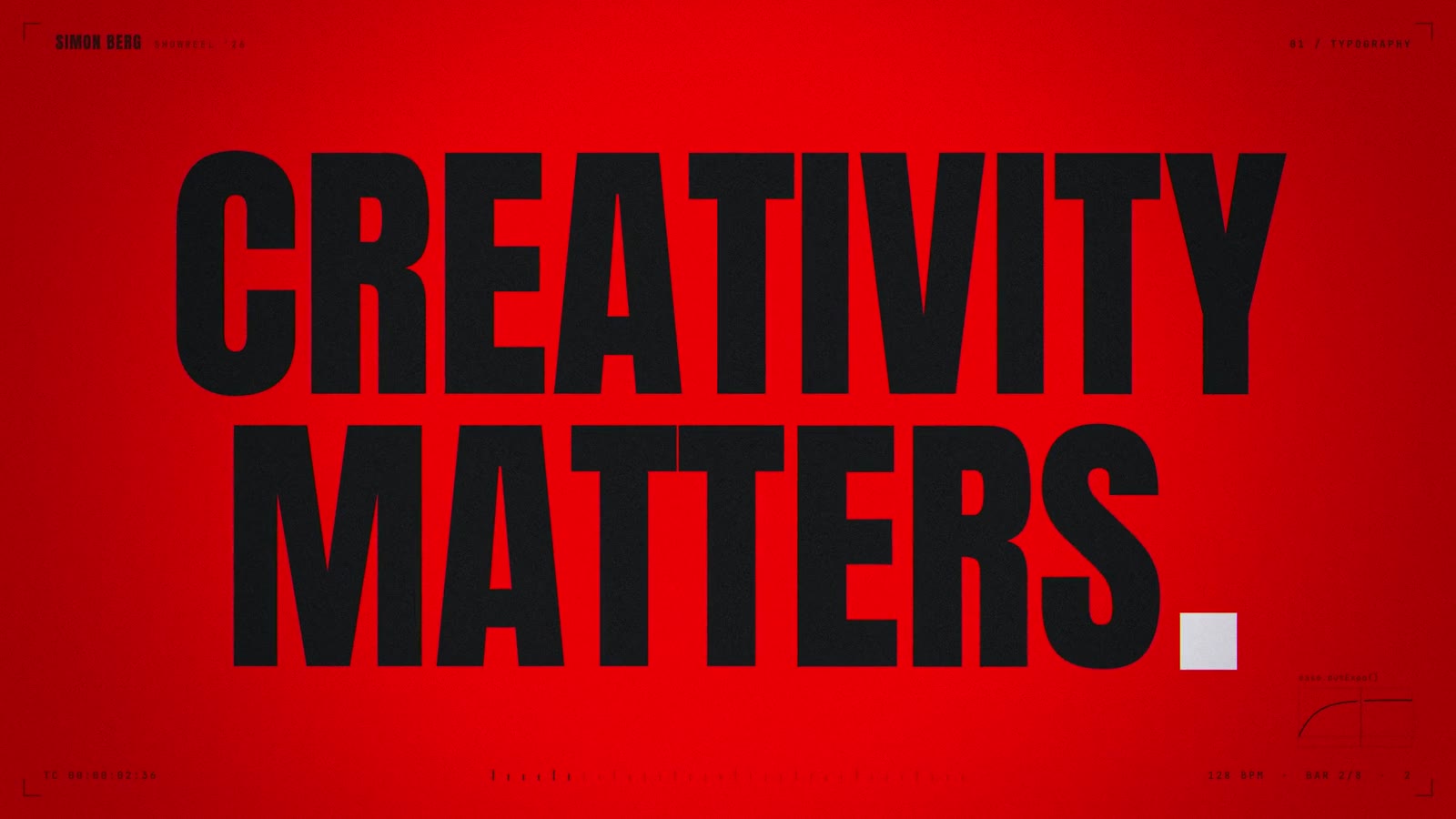
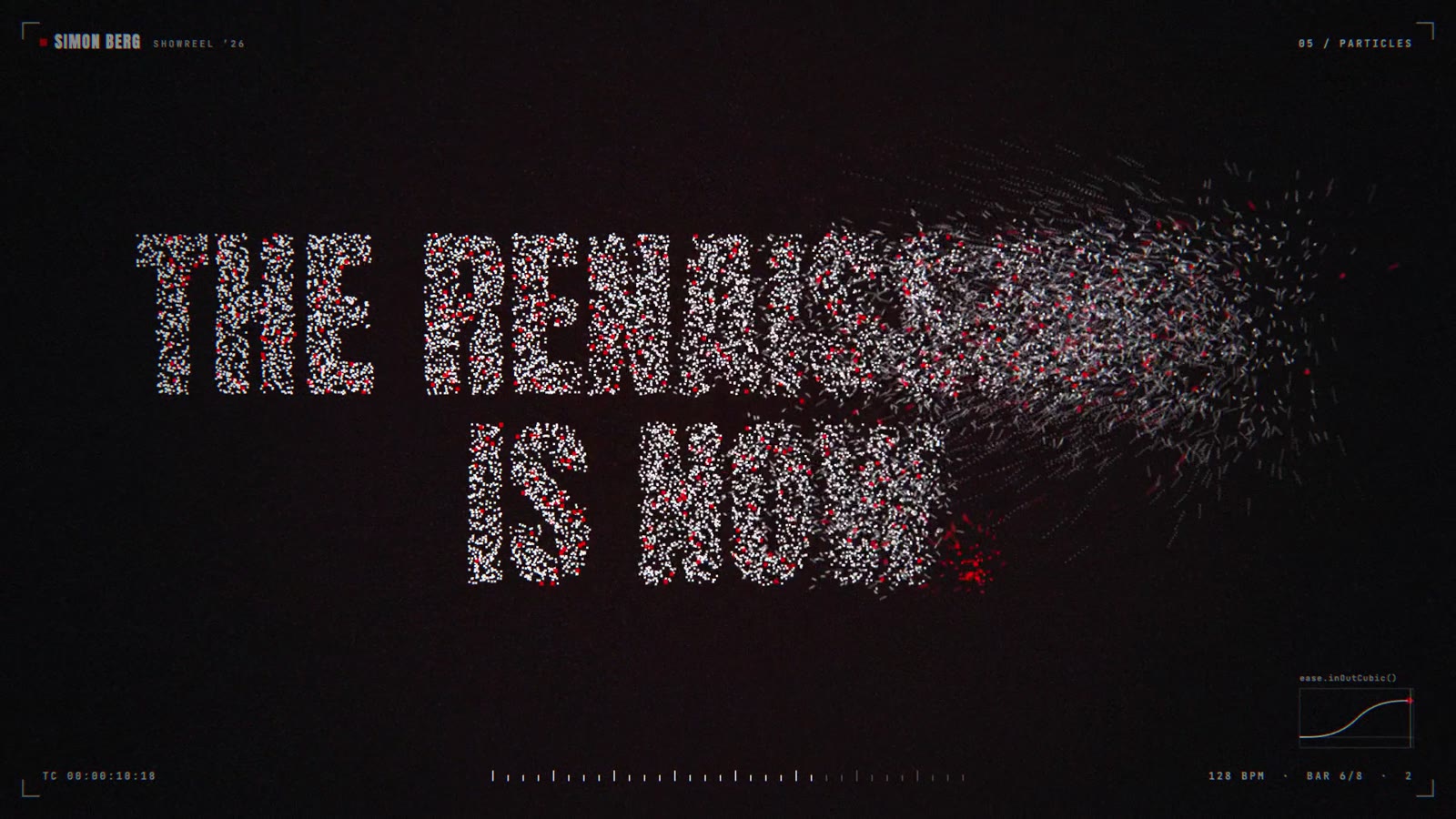
About half an hour after I hit send, I had a finished film at 1080p and sixty frames a second, with its own soundtrack. No stock footage. No templates. No AI video model. Every frame and every sound came from code it wrote. It drew all nine hundred frames in forty six seconds.
It also checked its own work before calling it done. It rendered test frames, looked at them, and caught three problems on its own: a glitch effect that never switched off and scrambled my logo, the word BUILD running off the edge of the frame, and a gradient that had gone too purple. And it told me plainly that it cannot hear, so it had checked the mix by measuring it instead.
My actual reply, and I stand by it.
Fucking insane!! Its sooo fucking good man.. I am kinda lost for words!!
Then I went through it frame by frame on the scrubber, trying to understand how it was made, and it explained something I had not appreciated. After Effects stores keyframes on layers. This film has no keyframes at all. Every frame is worked out from the time. The little red square's hop at the start is three lines of maths.
The question I keep asking
I have been going on about shared surfaces for a long time. In Peers, Not Seats I wrote that the future of working with AI is a shared workspace where we are both first class. Not a chat window you paste things out of. The same thing, open in front of both of you.
So I asked. If I wanted to edit some of this by hand, the way I would with a timeline in After Effects, could we build that? A surface where you and I both have full control of the same piece?
Its answer turned on one idea. The film should live in a document, not in code. The human edits the document through a proper interface. The AI edits the same document directly. Neither of us has a private copy, so neither of us is second class.
I told it to have a stab.
Twenty minutes
Twenty two minutes after I said go, the first live test passed. It changed a colour in the file, and the studio on my screen updated on its own, flashed the changed layer and told me Claude had done it. I pressed undo in the studio, and that undid Claude's change and wrote it back to the file.
What it built is called Motion Studio, and it runs in the browser on my machine. A viewer where you drag things around. A timeline with a beat ruler, markers and the soundtrack's waveform. Keyframes you can drag. An easing editor. Undo that covers both of us. And a button that renders the whole thing to an MP4.
Then it rebuilt the original film inside it. Fifty eight layers, all editable. It rendered the rebuilt version and compared it with the original frame by frame. They matched almost exactly.
Can you see what I did
I spent five minutes playing. Dragging words around, trying blend modes, changing the reveal on CREATIVITY a few times. At one point I typed CREATIV4 into it just to see what happened. Then I asked if it could see what I had done.
It could. The studio had logged every save. It walked me back through my last five minutes, step by step, including the things I had tried and undone. It noticed that one of my drags had added two new keyframes and nudged a word down about three pixels, and asked whether I had meant to.
I asked it to change the typo back. It edited the file, and the word corrected itself in the studio in front of me seconds later, flagged as Claude's edit. Everything else I had chosen, it left alone.
Dude you just built a whole motion graphics tool with agent and human parity of control.
That was me, again. Less sweary than the first one.
Where it is not equal yet
To its credit, it was straight with me about the gaps, in both directions.
It is ahead of me at some things. It can write whole new kinds of layers into the engine, and make a hundred edits at once that would take me an evening by hand. I am ahead of it at others. I watch the motion and I hear the music. It sees motion through still frames and cannot hear at all. And the soundtrack is still one fixed file, so if I retime the picture, the music does not follow yet.
It also pushed back when I got carried away. I told it anyone with a Claude account would want this, and it told me it is a convincing prototype, not a product. It runs on one machine, for one person, with no way to bring in your own footage. Its advice was to make three real pieces with it and put it in front of five people, and watch whether they reach for the timeline or for Claude.
Fair.
Why it matters more than the motion graphics
The film is the party trick, and it is a very good party trick. But it is not the point.
The point is the pattern underneath the studio. A structured document. A real interface for the human. And an agent with equal access to both. That pattern has nothing to do with motion graphics. It works for slides, for design, for data, for music. I spent years at Ceros working on interactive content, and I have been circling this idea ever since without seeing it this clearly.
Most AI video tools today work like a slot machine. You write a prompt, pull the lever, and hope. This is the opposite. Every frame comes from a document that a person and an agent can both change precisely, and both can see what the other did. For brand work, where the details are the whole job, that difference is everything.
Where it goes next
I would like to turn it into a proper Mac app, with a single button that connects it to Claude, so I can hand it to people and see what they do with it. That is the next job.
For now, I will say this. I started the week unable to keep up with the models. I ended it having made the thing I have been going on about forever, in an afternoon, with a head cold. I do not fully know what to do with that yet.
Si